Informatics
Informatics for Patient Safety
The effective use of informatics is nowadays a core competency that all healthcare professionals should acquire. Informatics is an interprofessional field that studies and pursues the effective use of data, information, knowledge and wisdom for scientific inquiry, problem-solving and decision-making. Informatics is more about people than technology. In other words, technology is there to enhance human capacity in dealing with data and information.
Within the patient safety sphere, the aim of informatics is to improve patient safety and provide safe healthcare for individuals, families and communities. Without informatics safety gaps cannot be identified nor system improvements made. It is well known that without measurement, improvement is not possible
Data, Information, Knowledge and Wisdom
The data, information, knowledge and wisdom (DIKW) framework helps us understand the concepts that form the science of informatics and how we as healthcare professionals have a major role to play starting from providing the required data and ending by the wise use of the resultant information and knowledge in order to achieve the desired aims and objectives.
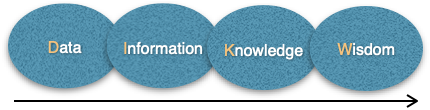
Data: Data is the basic element of any information system and it can be descriptions or measurements of phenomena, processes or items (age, medication, safety incidents).
Information: Meaningful aggregation / presentation of data (age groups, medication type, incident types).
Knowledge: Realisation of relations between sets of information (old age, sedatives and patient fall).
Wisdom: Using knowledge to solve problems and adding value to the public sphere (performing risk assessments and engaging patients in their safety).
International Classification for Patient Safety
The ICPS framework is composed of 10 classes. It aims to provide a comprehensive understanding of the domain of patient safety and to provide a method of organising patient safety data so it can be aggregated (information) and analysed (knowledge) to take action to minimise risk and improve patient safety (wisdom).
The ICPS also provides a structure for standardisation of the essential data required for safety incident reporting and analysis offering a true chance for information and knowledge sharing among healthcare providers.
The ICPS in its design represents a continuous learning and improvement cycle emphasising identification of risk, prevention, detection, reduction of risk, incident recovery and system resilience; all of which occur throughout and at any point within the framework.
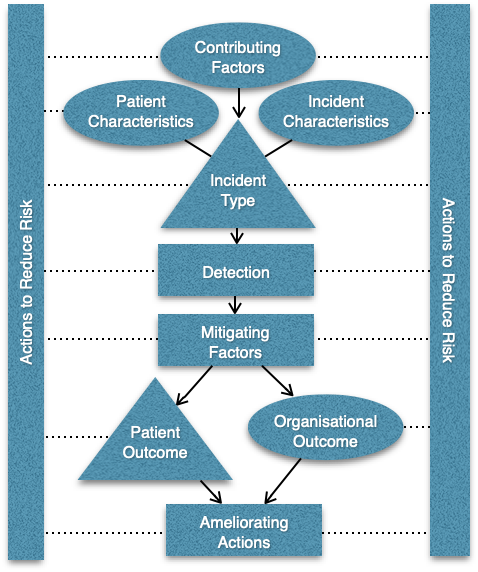
The ICPS framework is composed of the following 10 high level classes. Each class contains multiple subdivisions (concepts).
Contributing Factors/Hazards are the circumstances, actions or influences which are thought to have played a part in the development of an incident (staff: fatigue; patient: co-morbidity; work: poor lighting; organization: teamwork; external factors: faulty equipment).
Incident type is a descriptive term for a category made up of incidents of a common nature grouped because of shared, agreed features (clinical administration or procedure, documentation, infection, medication, blood, nutrition, gases, devices, behaviour, accidents, infrastructure, resources, management incidents).
Patient characteristics categorise patient demographics, the original reason for seeking care and the primary diagnosis (age, gender, diagnosis, procedure).
Incident characteristics classify the information about the circumstances surrounding the incident (origin, discovery, reporting).
Detection is defined as an action or circumstance that results in the discovery of an incident (change in the patient’s status, monitoring, alarm, audit, review, or risk assessment).
Mitigating factors are actions or circumstances which prevent or moderate the progression of an incident toward harming the patient. Mitigating factors are designed to minimise the harm to the patient after the error has occurred and triggered damage control mechanisms (directed to patients: education; staff: supervision; organization: protocols; or an agent: equipment maintenance).
Patient outcomes contains the concepts that relate to the impact upon a patient which is wholly or partially attributable to an incident (type of harm: ICD, degree of harm, social or economic impact: ICF).
Organisational outcomes refer to the impact upon an organization which is wholly or partially attributable to an incident (property damage, increase in resource utility, media attention, complaints, reputation damage, legal consequences).
Ameliorating actions are those actions taken or circumstances altered to make better or compensate any harm after an incident. Ameliorating actions apply to the patient (clinical management of injury, management of disability, compensation, disclosure, apology) and to the organization (claims management, staff debriefing, culture change, education and training).
Actions taken to reduce risk concentrate on steps taken to prevent the reoccurrence of the same or similar patient safety incident and on improving system resilience. Actions taken to reduce risk are those actions taken to reduce, manage or control the harm, or probability of harm associated with an incident (patient: adequate support; staff: training; organization: risk assessment; agent factors: forcing function).
ICD: International Classification of Disease
ICF: International Classification of Functioning, Disability and Health
Reading Material
-
- Kulikowski CA, et al. AMIA Board White Paper. J Am Med Inform Assoc. 2012;19:931–938.
- Ackoff RL. From data to wisdom. J Appl Syst Anal. 1989;15:3-9.
- The conceptual framework for the international classification for patient safety. WHO. 2009.